Physical Oceanography
We study ocean changes in the Gulf of Maine and Northwest Atlantic to better understand and predict conditions in a changing climate.
The Gulf of Maine and the Northeast US Shelf are among the fastest-changing ocean regions in the world. Climate variability and long-term warming are reshaping ocean circulation, temperature, oxygen, and marine ecosystems, with important implications for fisheries, marine habitats, and coastal communities. Our research focuses on key physical drivers of ecosystem variability, including the Mid-Atlantic Bight Cold Pool, Gulf Stream position and variability, warm-core ring activity, and Labrador slope water propagation. By improving our understanding of these mechanisms and their predictability, we aim to translate ocean science into actionable information.
We aim to:
-
Understand how ocean circulation, stratification, and temperature variability are changing across the Gulf of Maine and Northeast US Shelf.
-
Investigate the physical drivers of regional ocean variability, including Gulf Stream dynamics, warm-core rings, and shelf-slope exchange.
-
Improve prediction of key ecosystem driver variables such as temperature and oxygen across seasonal to decadal timescales.
-
Project future changes in ecosystem-relevant ocean conditions under multiple climate scenarios using high-resolution ocean and Earth system models.
-
Translate physical ocean insights into useful information for marine ecosystems, fisheries, and coastal decision-making.
Lab Team

Our Methods
Our lab seeks to understand, predict, and project changes in ecosystem-relevant
The Physical Oceanography Lab combines observational analysis, ocean dynamical diagnostics, and high-resolution ocean and Earth system modeling to investigate variability in ecosystem-relevant ocean conditions across the Gulf of Maine and the Northeast US Shelf. These complementary approaches allow us to investigate how large-scale climate variability and ocean circulation interact with regional shelf processes to shape ocean temperature, circulation, oxygen, and corresponding extreme events.
By integrating high-resolution numerical modeling, statistical analysis, and ocean-based diagnostics, we aim to improve understanding of coastal ocean dynamics, enhance prediction of environmental variability on seasonal to decadal timescales. In addition, we use high-resolution regional projections to assess how coastal ocean conditions may evolve under future climate change.
-
High-resolution earth system modeling
-
Ocean-based diagnostics and variability analysis
-
Extreme event detection and analysis
-
Prediction and climate projection frameworks
Our lab seeks to understand, predict, and project changes in ecosystem-relevant
The Physical Oceanography Lab combines observational analysis, ocean dynamical diagnostics, and high-resolution ocean and Earth system modeling to investigate variability in ecosystem-relevant ocean conditions across the Gulf of Maine and the Northeast US Shelf. These complementary approaches allow us to investigate how large-scale climate variability and ocean circulation interact with regional shelf processes to shape ocean temperature, circulation, oxygen, and corresponding extreme events. By integrating high-resolution numerical modeling, statistical analysis, and ocean-based diagnostics, we aim to improve understanding of coastal ocean dynamics, enhance prediction of environmental variability on seasonal to decadal timescales. In addition, we use high-resolution regional projections to assess how coastal ocean conditions may evolve under future climate change.
- High-resolution earth system modeling
- Ocean-based diagnostics and variability analysis
- Extreme event detection and analysis
- Prediction and climate projection frameworks
Lab Projects
-
![Gulf of Maine Temperature Reports]()
Gulf of Maine Temperature Reports
Over the past decade, scientists have led a body of research that highlights the rapid pace of warming in the Gulf of Maine. To help …
Our investigates the processes driving changes in the coastal ocean. By integrating satellite and in situ observations, ocean reanalysis products, and high-resolution ocean and Earth system models, we aim to improve understanding of ocean variability driven by climate and large-scale ocean circulation, and to enhance prediction of ocean conditions across the Northeast US Shelf.
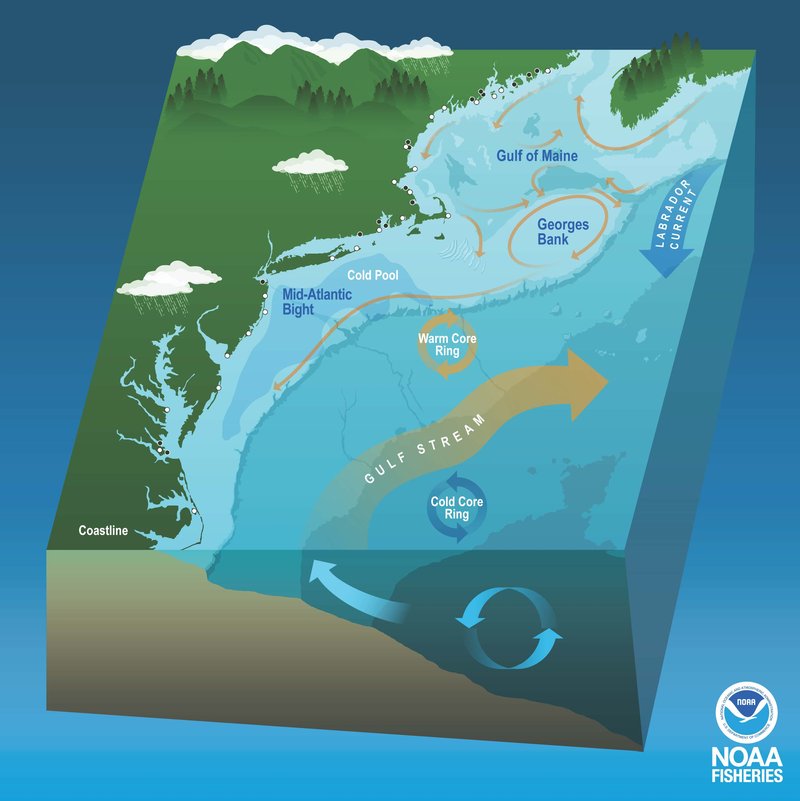
The Northeast US Continental Shelf ecosystem showing the Gulf of Maine, Georges Bank and Mid-Atlantic Bight regions as well as the dominant currents and oceanographic features. Credit: NOAA Fisheries.
Read more
-
Atlantic Meridional Overturning Circulation (AMOC) 101
This 101 explainer breaks down what the AMOC is, how it influences climate, what scientists are observing now, and what a changing AMOC could mean …
Explainers
-
2025 Gulf of Maine Temperature Report
Over the past decade, our scientists have led a body of research that highlights temperatures in the Gulf of Maine. To keep you informed, we …
Reports
-
2025 Research Progress Update
Each year, to keep you updated on our research team's progress, we develop an update showcasing some of our lab's achievements. More broadly, this update …
Reports
-
2025 Casco Bay Ecosystem Monitoring Report
Dive into the latest findings from a decade of nearshore monitoring in one of the world's fastest-warming marine ecosystems.
Reports