2025 – 26 Education Impact Report: 10 Years of Learning Ecosystems Northeast
Perspectives | Aug 26, 2026
Our education team helps young people build the confidence, skills, and curiosity to see themselves as scientists, both in the classroom and out in their own communities. Through hands-on programs rooted in real research, we connect students and educators alike with the tools and experiences they need to understand a changing climate and take part in shaping its solutions.
Read on to see some of the ways our education team made an impact across the state and beyond in the 2025 – 2026 school year.

During the 2025 – 26 school year, our education team continued to advance an integrated approach to learning in the classroom, lab, field, and beyond. This year carried extra meaning as we marked 10 years of Learning Ecosystems Northeast (LENE), a milestone reflecting a decade spent building community among educators across the region. Alongside that anniversary, we continued expanding access to hands-on learning experiences that strengthen climate and STEM literacy, and provided formal and informal educators with the professional development, curriculum resources, and networks they need to bring authentic science into their own classrooms and learning spaces.
Every priority in our 2025 – 2030 Strategic Plan depends on the same starting point — an educated public. Whatever the initiative, from adapting our fisheries to building climate-ready communities, that foundation is built early, in classrooms and libraries and community science projects, long before a student ever considers a career on the working waterfront or in ocean science. Our education programming is where that groundwork gets laid.
Numbers at a Glance
Take a look at some of the metrics we use to measure our impact.
Student Interactions
Year after year, we support climate and STEM learning for thousands of students.

Educator Interactions
Engaging with educators is one of the best ways to support STEM learning for youth.

Our educators filled out a survey this year, which provided us with insights into how valuable our educational programming is, and how we can continue making it even better.
Educator Confidence and Enjoyment
Nearly all educators who completed our survey said that our educational programming has boosted their confidence and enjoyment as educators.
Student Confidence in Science Learning
Similarly, educators overwhelmingly indicated that our support, which has no impact without educators taking it to their schools, has boosted their students' confidence as scientists and lea…

LabVenture
LabVenture sets students on the path of scientific discovery, building their confidence, competence, and curiosity as young researchers. The program invites early middle school students from across Maine to our Cohen Center for Interactive Learning, where they step into the role of scientist for a day, working hands-on with real Gulf of Maine data. This year, we again prioritized equitable access to STEM education, hosting every fifth grade classroom in Portland Public Schools, every sixth grade classroom in Lewiston Public Schools, and students from Indian Township, extending our reach into more of Maine's Wabanaki communities. Free transportation remained available to every participating public school, keeping the program within reach for rural communities across the state.
This school year marks LabVenture's 20th anniversary, two decades of hands-on science learning for Maine students. Since launching with "Mystery of the X-Fish" in 2005, the program has reached more than 175,000 students across the state. As we celebrate this milestone, we're also looking ahead. The LabVenture team continues to reimagine the program's curriculum and delivery, ensuring it keeps pace with the needs of Maine classrooms for the next 20 years.
LabVenture Numbers at a Glance
Students Engaged
Students from across Maine spent a day at the Cohen Center for Interactive Learning, working hands-on as scientists investigating real Gulf of Maine data.


Schools Served
Free transportation brought classrooms from every corner of the state through our doors this year.
Attending Educators
Teachers and chaperones joined their students at the Cohen Center for Interactive Learning, experiencing LabVenture's hands-on approach to Gulf of Maine science firsthand.

Wayfinder Wisdom
Our Wayfinder award winner, Jennifer Labonte, knows how important programs like LabVenture are for helping students think and feel like real scientists.
In school schedules, it’s not always easy to find enough time for deep, hands-on science. LabVenture changes that. It gives students the chance to immerse themselves in science — to think like scientists, to work with real tools, and to learn about the ecology of the Maine coast in a way that is both authentic and unforgettable… For twenty years, you’ve opened doors for our students — doors to curiosity, to exploration, and to futures they might not have imagined otherwise.
Jennifer LaBonte Instructional Specialist for Math and Science Lewiston Public Schools
Community Science
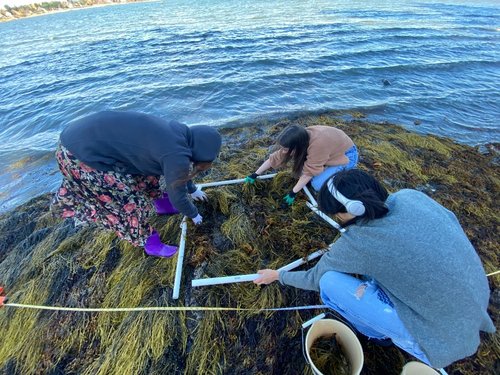
For science learning to stick, students need to see it show up in their own backyard. Our Community Science program makes that connection real, supporting educators as they lead students through hands-on investigations of the ecosystems right outside their classroom door.
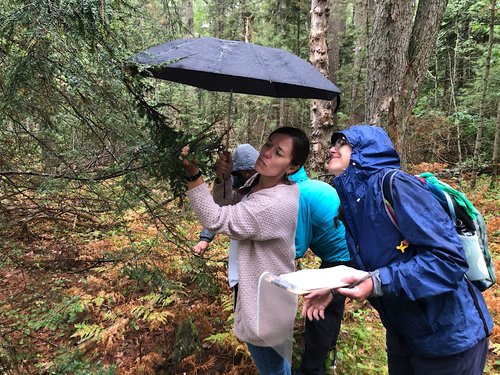
This year, students carried out field investigations and stewardship work across a range of local ecosystems, contributing real data to ongoing research in their communities. In one project, Protecting Ash, students partnered with foresters and community members to track the health of brown ash trees threatened by the invasive emerald ash borer. Students at schools like Windham High School turned their research into something their whole community could see, building and installing signage along the trail to share what they'd learned.
Community Science Numbers at a Glance
Students Engaged
Students investigated the ecosystems in their own backyards, from intertidal zones to forest floors, generating real data for real research.
Educators Supported
We equipped educators with the training and tools to lead authentic, place-based scientific inquiry in their own communities.
Ever since we started this, I’ve been identifying ash trees everywhere I go. My friends ask, ‘Why are you talking about trees so much?’ And I tell them, ‘Because it matters. The trees are endangered. This makes them aware, too, even if they’re not in class with us.’
Student Participant Ash Tree Community Science Project
Findings from the Field
Findings from the Field is a peer-reviewed journal built entirely around student research, giving middle and high schoolers a real venue to design investigations, collect data, and publish original environmental science. Since its 2017 launch, the program has grown into a community of student scientists and educators spanning Maine and New Hampshire.
This year, we published Findings: Volume 9 and, in March, welcomed 106 students, along with educators and professional scientists, to the Findings Research Symposium at Unum. GMRI Chief Impact Officer Dave Reidmiller opened the day with a reminder that "science is a team sport," a theme that carried through as students presented their research alongside high schoolers and working scientists. For some students, the research led to real-world impact. Students in Old Orchard Beach identified the invasive hemlock woolly adelgid in their community and shared their findings with the Maine Forest Service, contributing to ongoing efforts to manage its spread.
Findings Numbers at a Glance
Students Engaged
Student scientists carried their own investigations through writing, peer review, and publication, seeing their work through from question to finished article.


Educators Supported
We supported educators across every part of the program, from guiding students through the journal's writing and review process to attending the symposium and connecting with the broader Fin…
Student Publications
Each of these articles passed through a full peer and editorial review process before appearing in the journal. In total, there were 27 student authors across these 13 publications.

I would like you to know that this has been one of the coolest events I have been to. Hopefully, I get to do this next year.
Student Symposium Attendee
Scientist To Go
Scientist To Go connects students with working scientists through a virtual lecture series, offering a window into scientific fields and career paths they might not otherwise encounter in the classroom. This year, students heard from both our own scientists and researchers from partner organizations, gaining a broader sense of the range of people and paths behind real scientific work.
Scientist To Go Numbers at a Glance

Webinars
We brought a rotating slate of working scientists into classrooms virtually, spanning fields from meteorology to marine biology.
Students Engaged
Students logged on to hear directly from scientists about their research, their careers, and how they got there.
Learning Ecosystems Northeast
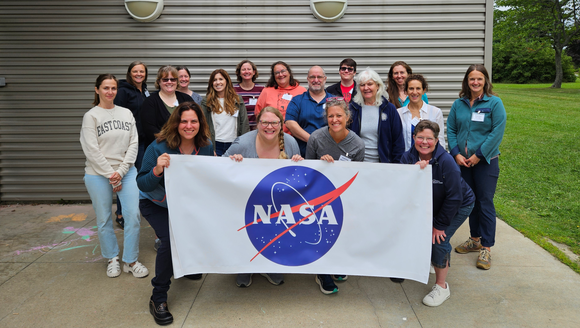
Our education team knows that young people learn science best when they can explore it in more than one place, in the classroom, in their community, and everywhere in between. For 10 years, that idea has shaped our investment in Learning Ecosystems Northeast (LENE), a partnership of organizations that equips educators across the Northeast with the tools, knowledge, and community to build inclusive, place-based, data-driven STEM learning experiences. Through LENE's network of Connected Learning Ecosystems (CLEs), we bring educators together to learn from and with each other, sharing resources, ideas, and experience across formal and informal learning settings.
What started as a handful of educators building communities in Maine has grown into a Northeast-wide network of schools, libraries, science centers, and nonprofits, all working toward the same goal of building climate literacy in their communities, and giving young minds opportunities to engage in authentic science. To mark this milestone, we're sharing the story of Sherri Calhoun, an educator who has grown alongside LENE since its earliest days. Her journey captures what almost a decade of this network has built for educators across the region, a lasting community centered on a shared commitment to STEM and climate learning. For more educator perspectives on what LENE has meant to their teaching practice, visit our story on the impact of LENE.
LENE Numbers at a Glance
Connected Learning Ecosystems (CLEs)
Each CLE brings together educators across a region to share resources, plan collaboratively, and strengthen climate and science learning in their communities.


School and Organization Partners
Schools, libraries, science centers, and nonprofits across the Northeast partnered with LENE to bring place-based STEM learning to their communities.
Educators Supported
LENE connected formal and informal educators across Maine and the Northeast with resources to grow their teaching practices.

Appendix: Our Education Supporters
Our work is only possible because of the federal, corporate, and foundation partners listed below, alongside the individual donors whose generosity sustains our education programs year after year. We're grateful to each of them.
Federal Sponsors
This material is based upon work supported by the National Aeronautics and Space Administration under Cooperative Agreement No. NNX16AB94A issued through the Science Activation program at Science Mission Directorate.

This material is based upon work supported by the National Science Foundation under Grants No. 2010119 and 2115603. Any opinions, findings, and conclusions or recommendations expressed in this material are those of the author(s) and do not necessarily reflect the views of the National Science Foundation.
Lead Education Supporters


Lead LabVenture Supporters


Additional Corporate and Foundation Supporters
- Alfred M. Senter Fund
- Altrusa International of Greater Biddeford-Saco, ME
- Bank of America Charitable Foundation, Inc.
- Bath Iron Works
- Bath Savings Institution
- Beim Foundation
- Charles C. Butt
- Charles E. Miller Foundation
- Clark Insurance
- George P. Davenport Trust Fund
- Hoyt Charitable Foundation
- Hyman Family Foundation
- Katahdin Trust Company
- Kennebunk Savings Bank
- KeyBank of Maine
- L. L. Bean, Inc.
- Machias Savings Bank
- Maine Timberlands Charitable Trust
- Margaret E. Burnham Charitable Trust
- Marr-Anderson Family Foundation
- MMG Insurance
- Norway Savings Bank
- Old Bug Light Charitable Foundation
- P.W. Sprague Memorial Foundation
- Pond Family Foundation
- Portland Pipe Line Corporation
- RBC Wealth Management
- Renys & Reny Charitable Foundation
- Robert G. and Jane V. Engel Foundation
- Saco & Biddeford Savings Institution
- Sam and Mary Lawrence Foundation (Sea2Earth)
- Skowhegan Savings Bank
- Seth Sprague Educational and Charitable Foundation
- Windover Foundation
- Youth Learning As Citizen Environmental Scientists
We also work closely with a team of committed partners and vendors who are critical in executing our program: Cyr Bus Lines, Custom Coach, and Upswell.
Thanks to our Endowment Supporters:
In addition to the annual supporters listed above, LabVenture is made possible by an endowment seeded by the Lunder Foundation in 2015 and the contributors who have invested in the legacy of this program and its impact. 2025 – 26 endowment contributors include the Sam L. Cohen Foundation, which has been a key supporter of LabVenture since 2005.