2025 Research Progress Update
Reports | Jan 27, 2026
Each year, to keep you updated on our research team's progress, we develop an update showcasing some of our lab's achievements. More broadly, this update describes how our research program leverages its capacity to attract funding, produce data-driven results, and foster relationships within the scientific community.
GMRI Research at a Glance
Here's a quick look at things like research team size, our research budget, publications, and more.
Research Team Size
Full-time GMRI Research Staff
Our full-time research team continues to grow year over year.
Interns
Interns from all around the country came to Maine to support our work last year.
Budgets, Grants, and Contracts
Total Research Budget
Our research expenditures increased compared to last year by over $800,000.
Active Grants and Contracts
We saw a surge of grants and contracts this year, with 16 more than 2024.
Funding Requested
Federal Funding
Of the $12m, we were awarded $675k, with $4.5m more pending.
Foundation Funding
We were awarded $1.13m of our requested amount, with $710k pending.
Proposals Submitted for Funding
Explore other projects that have been funded by proposals like these in years past.
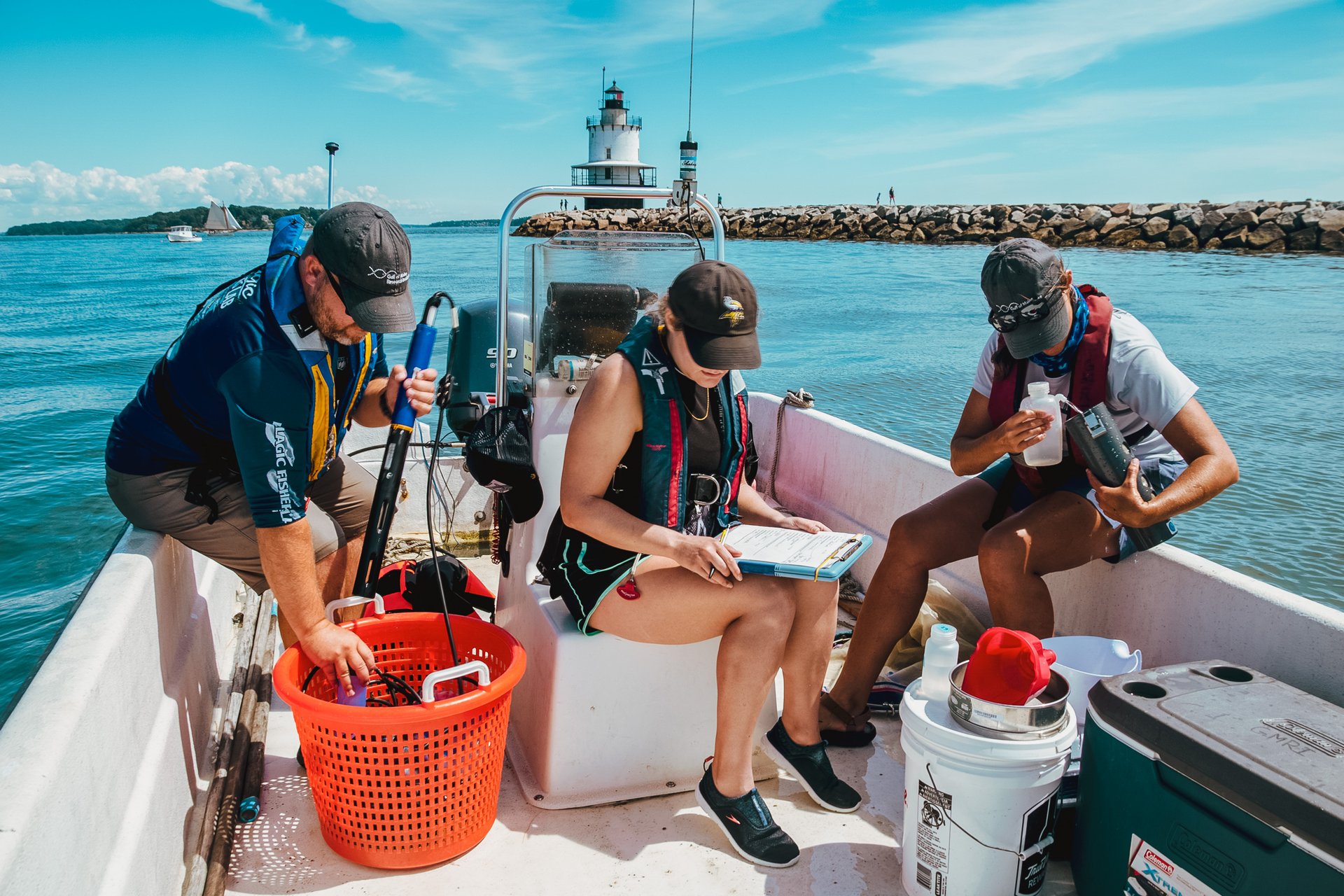
Person Days on the Water
Our researchers conducted field research for 76 days on our skiff, 202 days on the Merlin, and 20 days on the Gadid.
Total Publications
We also saw a dramatic increase in research publications this year, compared to years past.
2025 Research Highlights
In 2025, GMRI researchers advanced science that supports resilient fisheries, healthy ecosystems, and climate‑ready coastal communities in the Gulf of Maine and beyond. Across disciplines, research focused on understanding rapid ocean change, strengthening connections between physical and ecological processes, and translating scientific insights into tools and knowledge that inform decision‑making.
A major milestone this year was the development of our FY26 – FY30 Strategic Plan, which aligns research priorities with four cross‑cutting initiatives: Adapting Fisheries and Seafood, Building Climate‑Ready Communities, Developing the Blue Economy and Working Waterfronts, and Supporting Energy Solutions. Our research contributes directly to these initiatives, ensuring that science remains tightly connected to real‑world challenges and opportunities.
We also expanded our research capacity in 2025, welcoming new scientific leadership and establishing new labs. These investments strengthen our ability to understand how climate‑driven changes in ocean conditions shape ecosystems, fisheries, and coastal systems — and to anticipate what those changes mean for the future.

Expanding the Research Department
To deliver on our mission, the science division expanded its capacity this year. We hired new full-time scientists and created new labs leading innovative research, which will ensure that programs have the depth and expertise needed to support communities, industries, and ecosystems.
Physical Oceanography Lab:
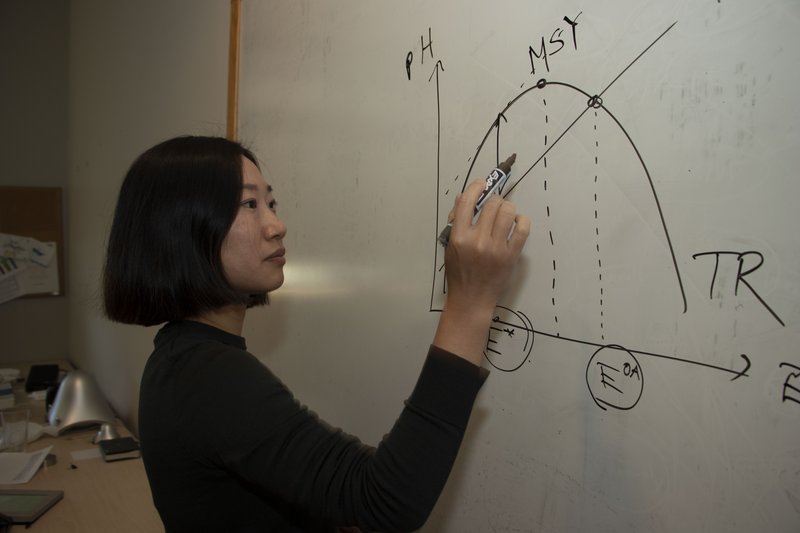
In September 2025, we welcomed Zhuomin (Jasmine) Chen, PhD, as a Senior Research Scientist in Physical Oceanography, establishing a new lab in the research department. Her expertise in coastal and shelf ocean dynamics adds critical capacity for understanding the physical processes shaping the Gulf of Maine, including climate-driven changes to circulation and stratification. Dr. Chen’s work strengthens our ability to link physical and ecological dynamics, providing essential insights for fisheries, coastal communities, and ecosystem resilience. She will be leading our future warming updates.
Spatial Dynamics Lab:
Andrew Allyn, PhD, began transitioning his role to establish a new Spatial Dynamics Lab within the research department. His work will focus on advancing the use of spatial data and modeling to understand how marine species, ecosystems, and human activities interact across scales. This new lab will provide critical tools for ecosystem-based management and for anticipating how climate change and human use patterns reshape the Gulf of Maine and beyond. He will also be introducing research around seabirds and their connection to Gulf of Maine ecosystems.
Coastal Dynamics Lab:
The Coastal Dynamics Lab, led by Hannah Baranes, PhD, was formally established within the research department following its transition from the now discontinued Climate Center. The lab focuses on understanding how physical and climatic drivers influence coastal systems, with projects ranging from expanding Maine's tide gauge network to support coastal flood forecasting and management to investigating how tidal flats respond to sea level rise. Katie Giannakopoulos, (MS, Research Associate), brings expertise in atmospheric sciences, with a focus on the interactions between weather, climate, and coastal systems. She is currently studying the atmospheric drivers and coastal impacts of winter-season "Sou'easter" storms that caused widespread damage in Maine in 2023 and 2024.
Partnerships
Partnerships remain central to our research approach, enabling collaborative science that spans institutions, disciplines, and communities.
Key Research Partners
We entered into a new agreement with the University of New England (UNE), creating a flexible framework for collaboration across marine science, fisheries, climate resilience, data science, and education. This partnership launched with a joint symposium, Ocean Connections: Advancing Science through Collaboration, which brought together researchers from both institutions to identify shared priorities and develop new project concepts. Building on this momentum, GMRI and UNE established a Research Accelerator program to provide seed funding for collaborative projects and support future external funding proposals.
Northeastern University and the Roux Institute:
We continued and deepened collaborations with Northeastern University and the Roux Institute, particularly around the application of advanced data science and artificial intelligence to marine ecosystem and fisheries research and coastal flood decision-support tools.
We are in our final year of a partnership between Quahog Bay Conservancy (QBC), GMRI, and the University of Maine to expand undergraduate internship and training opportunities in coastal Maine. Dr. Katie Lankowicz, a postdoctoral associate working in Dr. Graham Sherwood's lab, is based at QBC June – August each year to provide mentoring and guidance to summer interns. QBC also supports the expansion of our CBASS work.
Lab Updates
Fisheries Ecology Lab
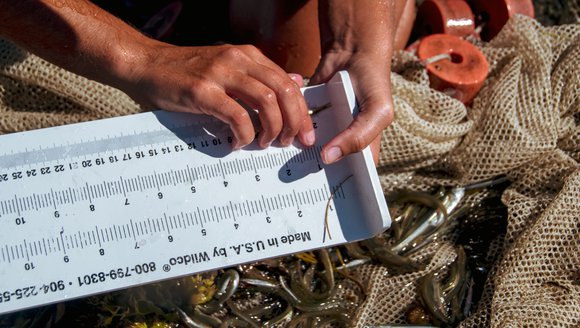
The Fisheries Ecology Lab expanded its research portfolio in 2025, advancing work on fish population dynamics, habitat use, and ecosystem monitoring in the Gulf of Maine. Core efforts continued through the Casco Bay Aquatic Systems Survey (CBASS), which tracks nearshore ecosystem change through long‑term monitoring of fish, plankton, and environmental conditions. CBASS data inform the annual Casco Bay Ecosystem Report (2023, 2024) and support student research and internship projects.
The lab also advanced research on cod and groundfish ecology, selective fishing gear, and offshore wind–fisheries interactions, combining field surveys, modeling, and stakeholder engagement. Together, these projects contribute to a better understanding of how fisheries and ecosystems are responding to warming waters and changing ocean conditions.
Integrated Systems Ecology Lab
The Integrated Systems Ecology Lab continued to advance research on how climate variability and ecosystem change affect marine species, habitats, and fisheries. Researchers applied spatial and ecosystem modeling approaches to examine shifts in species distributions, predator–prey interactions, and habitat use under changing environmental conditions.
The lab also contributed to seasonal and annual analyses of ocean conditions in the Gulf of Maine, helping translate complex data into accessible insights for managers and the public. This work supports more adaptive approaches to fisheries management and climate resilience planning.
Physical Oceanography Lab
We established a new Physical Oceanography Lab, expanding research focused on the drivers and predictability of ocean change. The lab investigates key physical processes — including temperature variability, marine heat waves, circulation patterns, and shelf‑slope exchange — that influence marine ecosystems in the Gulf of Maine and Northwest Atlantic.
Collaborations with academic and federal partners are advancing projections of future ocean conditions under different climate scenarios. Beginning in 2026, this lab will lead our flagship Gulf of Maine warming reporting, strengthening connections between physical ocean science and ecosystem‑based research.
Spatial Dynamics Lab
The Spatial Dynamics Lab advanced research focused on understanding how marine species, ecosystems, and human activities interact across space and time. Using spatio-temporal modeling frameworks and integrated survey datasets from across U.S. and Canadian waters, the lab examined climate-driven shifts in species distributions, migration patterns, and ecological interactions. This lab will also explore research on seabirds in the Gulf of Maine.
This work supports ecosystem-based management and improves the ability to anticipate how climate change and changing ocean conditions will reshape fisheries and marine ecosystems in the Gulf of Maine and the broader Northwest Atlantic.
Biological Oceanography Lab
The Biological Oceanography Lab focused on understanding how biological and physical processes interact to shape marine ecosystems, from plankton dynamics to higher‑trophic‑level species. Research in 2025 included analyses of long‑term plankton datasets, studies of species movement and habitat use, and contributions to global research on the biological carbon pump.
This work connects local observations in the Gulf of Maine to broader regional and global ocean processes, strengthening understanding of how climate change influences marine food webs and carbon cycling.
Coastal Dynamics Lab
The Coastal Dynamics Lab advanced research on sea‑level rise, coastal flooding, and storm impacts, with a focus on translating physical science into tools that support community resilience. Projects combined modeling, data analysis, and visualization to help coastal communities understand and plan for changing risks.
Ocean Data Products Lab
The Ocean Data Products Lab continued to develop and maintain digital tools and platforms that support data-driven ocean and coastal research. In 2025, the lab enhanced systems for managing, visualizing, and sharing complex environmental datasets, supporting both internal research and external partners.
The lab also advanced community science and data governance efforts, including projects that balance open data access with data sovereignty and privacy considerations. These efforts help ensure that ocean data are both usable and responsibly managed.
Coastal and Marine Economics Lab
The Coastal and Marine Economics Lab examined how environmental change, management decisions, and market dynamics shape coastal and marine economies. Research in 2025 included analyses of fisheries economics, seafood supply chains, and the social and economic dimensions of climate adaptation.
This work supports more informed decision-making by linking ecological change with economic outcomes for fisheries, communities, and regional food systems.
Learning Sciences Lab
The Learning Sciences Lab advanced research focused on how people learn complex scientific concepts related to climate, ecosystems, and computing. Through research–practice partnerships, the lab studied instructional approaches that support systems thinking, data literacy, and engagement with real-world environmental challenges.
This work informs the design of educational programs and tools that connect research, learning, and impact.