Sea State Recap: Adapting Fisheries & Seafood
Perspectives | Jan 22, 2026
At our most recent Sea State seminar, we explored what it means to support resilient fisheries and seafood systems during a period of rapid change and increasing socioeconomic and environmental pressures. Our three featured speakers shared local, national, and global approaches to fisheries and ecosystem education, management, and collaboration.
Reaching the Next Generation with LabVenture
Meredyth Sullivan, Senior Program Manager for our LabVenture Program, opened the evening with a look into how we are reaching Maine students with hands-on science experiences that inspire curiosity and critical thinking about the Gulf of Maine. Experiences like these are shown to support life-long understanding of data and science, which helps the next generation in becoming better stewards of important resources, like fisheries. "We're not just introducing kids to science — we’re inviting them to be scientists," Sullivan said.
Each year, roughly 70% of fifth and sixth graders in Maine participate in this free program, traveling from across the state to our Cohen Center for Interactive Learning. During their visit, students work in groups at digital touch tables, handle live lobsters, view plankton under microscopes, and use authentic data tools to age fish and build growth charts. They explore questions like "What’s happening in the Gulf of Maine? How do we know? Why does it matter?"
We're not just introducing kids to science — we’re inviting them to be scientists.
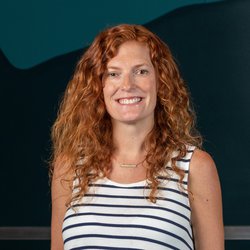
![]() Meredyth Sullivan LabVenture Senior Program Manager
Meredyth Sullivan LabVenture Senior Program Manager
Sullivan emphasized the importance of reaching students during their middle school years — a time when many begin to form long-lasting perceptions of science. She mentioned research that demonstrates that as students get older without being exposed to science, particularly at this critical age as middle schoolers, they find it harder to see the value of science in high school and college and on to their older adult years.
Sullivan described how this experience can shift students’ perceptions of science — especially for those who may not see themselves as “science kids.” The LabVenture program creates opportunities for students to connect their lived experiences to large-scale environmental challenges and solutions. "They arrive with their own ecological knowledge, and they leave knowing that knowledge matters," she noted.
She also described how the program builds data literacy and a sense of agency. “What we really want to do is help young people see science as a tool that they can use,” she noted. “It’s not something that belongs just in a textbook.”
Bridging the Gap Between Science and Industry
Next, John Williamson, commercial fisherman and co-founder of the Marine Resource Education Program (MREP), offered a personal and powerful account of how collaboration between fishermen and scientists has improved fisheries management over the past three plus decades.
Reflecting on his career, Williamson recalled the turning point in the 1990s when groundfish stocks collapsed and regulatory tensions ran high. Fishermen and scientists, often on opposite sides of the table, began to find common ground out of necessity and a shared goal to improve the tools and resources. "Science is statistics. Fishing is experience. You need both," Williamson said.
Williamson explained how cooperative research helped shift dynamics — giving fishermen a voice in the science and data collection process. One project established semi-annual nearshore trawl surveys in areas inaccessible to federal survey vessels. Local fishermen led the design and continue to collaborate with scientists to conduct the sampling to ensure quality, resulting in data still used in stock assessments today.
Science is statistics. Fishing is experience. You need both.
John Williamson Commercial Fisherman and MREP Co-Founder
He highlighted how GMRI supported an early matchmaking effort between fishermen and researchers, leading to over 200 cooperative research projects. This collaboration laid the foundation for MREP to address a deep frustration fishermen felt as they were being left out of the confusing and complex federal fishery management process. MREP collaboratively designed for fishermen, by fishermen, teaches fisheries science, management, policy, and ways to get involved to fishermen across the country.
"That’s how MREP got started. Fishermen needed to understand the science, and scientists needed to understand the fishery," he said.
He also underscored the program’s role in improving stakeholder dialogue. With more informed participants at the table — whether they are fishermen, scientists, or regulators — the decision-making process becomes more transparent, more productive, and more inclusive. MREP is now operating in all eight federally-managed fishery zones ensuring that fisheries management isn't something done to fishing communities, but something done with them. With climate change and other rapid changes happening in the fisheries space, this 25 year old program is more vital than ever to these communities and processes. GMRI has been an implementation partner for 20 years.
A Global Strategy for Resilient Fisheries
Dr. Kristin Kleisner, Associate Vice President and Lead Senior Scientist for Ocean Science at the Environmental Defense Fund (EDF), closed the evening by offering a global perspective on climate-ready fisheries.
Kleisner described the FishSCORE2030 initiative — a collaboration co-led by GMRI and EDF under the UN Decade of Ocean Science. The initiative supports science-based management across global fisheries systems and aims to help communities adapt to climate change while protecting marine biodiversity. "The challenge is global, but the solutions must be local," she said.
Through more than 18 case studies, Kleisner and her team have identified common traits among resilient fisheries: access to information, adaptive institutions, and strong community leadership. "We’re working with fishers, scientists, and policymakers to understand what makes a system able to absorb shocks and still thrive," she noted.
A key outcome of the project is a new Climate Resilient Fisheries Planning Tool. This tool helps fisheries stakeholders assess vulnerabilities, explore potential management scenarios, and plan for long-term adaptation. "It’s not just about today’s catch. It’s about ensuring communities can fish tomorrow — and ten years from now."
Kleisner also highlighted how the FishSCORE2030 community has grown into a global learning network. Over 650 people from 85 countries are now part of the conversation, sharing insights on climate-resilient practices.
It’s not just about today’s catch. It’s about ensuring communities can fish tomorrow — and ten years from now.
Kristin Kleisner, Ph.D. None Environmental Defense Fund
She emphasized the importance of mutual learning across regions. “There’s enormous value in hearing what’s working somewhere else — even if the context is different. It’s about seeing patterns, building trust, and making smarter decisions together.”
Looking Ahead
This seminar illuminated the interconnected pathways to building resilience in our fisheries and seafood systems— from educating the next generation and empowering fishermen to strengthening global partnerships. These stories underscored how knowledge sharing, hands-on engagement, and collaboration at every level can help communities and ecosystems adapt and thrive in the face of many challenges.